# TESSERA v1.1: more stable embeddings, fewer artefacts
Date: 2026-06-09
Author: Anil Madhavapeddy and Frank Feng on behalf of team TESSERA
Canonical URL: https://geotessera.org/blog/2026-06-09-tessera-v1-1
We're pleased to announce the availability of TESSERA v1.1, a retrained
successor to our original v1.0 model. If you use TESSERA embeddings for any
downstream tasks such as classification, change detection, regression, then the
new embeddings are drop-in replacements that will improve accuracy. Your code
and workflow stay exactly the same; the only step is to re-download the
embeddings for your region as v1.1 and re-run.
## What's better for your downstream tasks
- More **temporal stability** year-on-year. v1.1 128-dim embeddings are more
consistent across years for the same location. That makes multi-year work such
as change detection, trend analysis, or training a classifier on one year and
applying it to another, much more reliable.
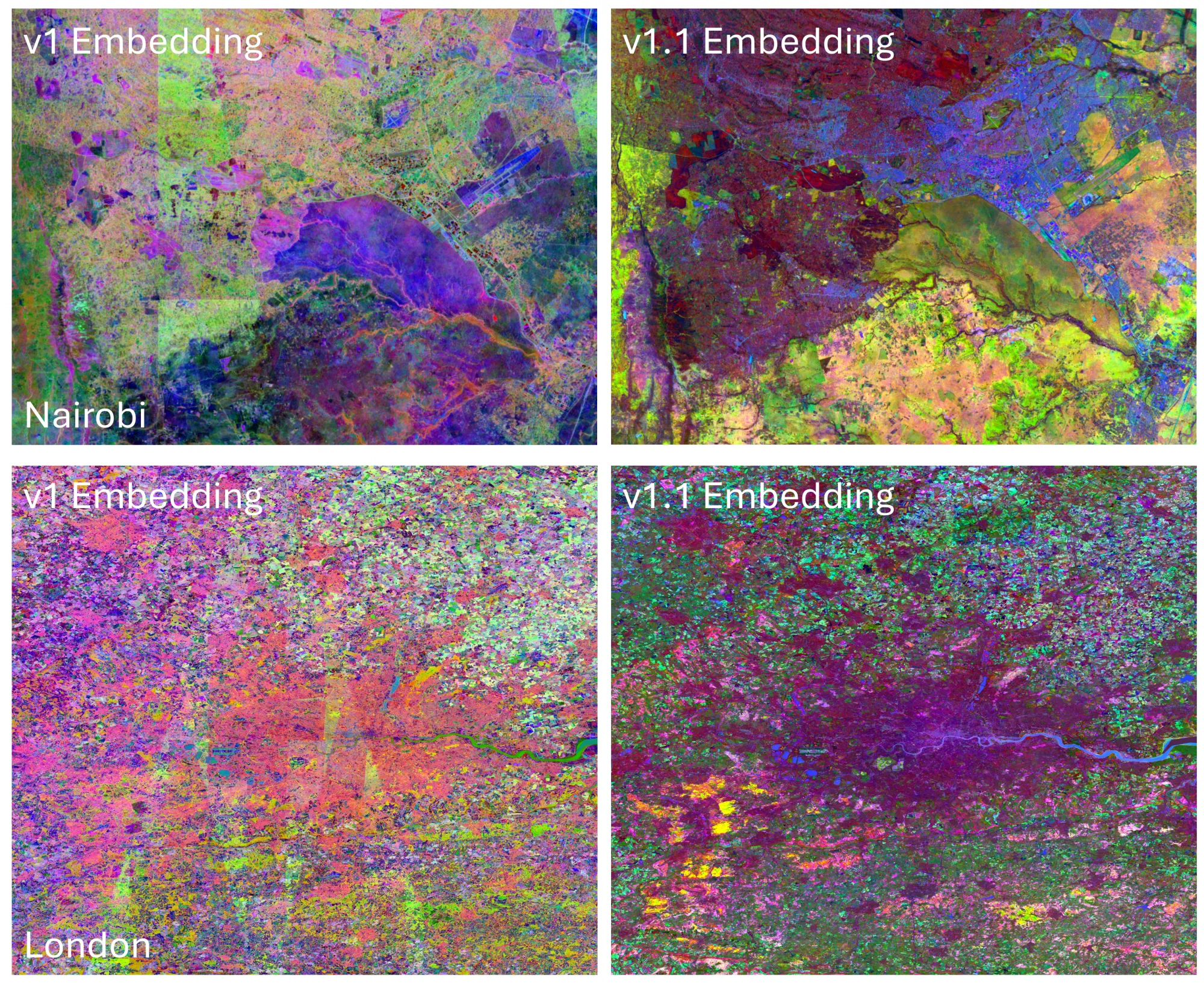
- **Fewer artefacts in sparse or imbalanced observation areas.** v1.0 could
sometimes produce noisy tiles in places with few clear satellite observations
due to persistent cloud, short time series, or sensor gaps. It could also show
boundary-like artefacts where observation counts changed abruptly across
acquisition or tiling boundaries—for example, along Sentinel-1 ASC/DESC
coverage edges where one side of a boundary may have ~100 valid observations
and the other ~150. v1.1 handles both sparse and highly imbalanced observation
patterns more gracefully, so quality holds up in the places that formerly
showed issues. Note that this only affected large-scale downstream tasks; if
you used a small ROI that didn't straddle problematic tiles, there will be no
change.
- **Improved coastal coverage** v1.0's land mask was too aggressive and dropped
legitimate land pixels in coastal areas. We've listened to our mangrove-loving
friends and extended the training and inference buffer to 20km to cover
coastlines and remote islands.
v1.0 vs v1.1 embeddings — the same regions visualised in false colour, with v1.0 on the left and v1.1 on the right. Notice the suppressed tiling seams and cleaner structure in low-observation areas.
## Getting the embeddings
Upgrading is two steps: install the latest geotessera, and ask it for v1.1
embeddings instead of v1.0. Everything downstream of that — the array shapes,
the dequantisation, your classifier or pipeline — is unchanged.
The easiest path is the [geotessera](https://geotessera.readthedocs.io) Python
library, and we're delighted that
[geotessera 0.9.0](https://github.com/ucam-eo/geotessera/releases/tag/v0.9.0) is
out today to go alongside the v1.1 release. It supports both v1.0 and v1.1
embeddings, so you can select whichever version you need. Pass `--dataset-version v1.1` to upgrade. There is also a new
`--dataset-variant` flag, since we now have multiple parties generating
embeddings for the community:
- The `vultr` dataset-variant is the original full global run of **v1.0**.
- The `cambridge` dataset-variant is **v1.1**, run on our University servers. It
is a small-scale variant we are generating for early adopters of 1.1, so use
this to try 1.1 immediately.
- A `default` dataset-variant will be a Zarr-native full global run of **v1.1**
by [Cyclops.AI](https://www.cyclops.ai/), covering 2016-2025 for the whole
world and hosted on AWS for cloud-native streaming access. We expect this to
complete in the next 2-3 months, so stay tuned for more news!
These are distinct runs rather than mirrors of one another: they may share a
model but differ in infrastructure, extent, and processing, so embeddings can
differ slightly between variants. Pick one variant and stay on it within a given
analysis for consistency.
You don't even need to install anything to try it — [uvx](https://docs.astral.sh/uv/)
will fetch and run geotessera in one shot. For example, to grab the v1.1
embeddings over the UK for 2024 as numpy arrays:
```bash
uvx geotessera download \
--country "United Kingdom" \
--year 2024 \
--dataset-version v1.1 \
--dataset-variant cambridge \
--format npy \
--output ./uk-v1.1
```
Run `uvx geotessera download --help` for the full set of options — you can
select a region by `--bbox`, `--tile`, `--country`, or a `--region-file`, and
choose between georeferenced `tiff` (the default) and raw `npy` output.
All the TESSERA embeddings (both v1.0 and v1.1) are now available in AWS Open
Data in the `tessera-embeddings` S3 bucket. The geotessera 0.9 release defaults
to using S3 to fetch the embeddings, which should be more reliable for everyone.
Let's however take a moment to remember the overloaded Cambridge University server
that bravely served embeddings for the first six months of TESSERA all by itself.
Thank you "okavango" for not crashing and taking all our embeddings with you!
## Running or fine-tuning the model yourself
If you'd rather generate your own embeddings or fine-tune on your own data, the
v1.1 weights are on Hugging Face:
- **[huggingface.co/geotessera/TESSERA-V-1.1](https://huggingface.co/geotessera/TESSERA-V-1.1)**
- **[huggingface.co/geotessera/TESSERA-V-1.0](https://huggingface.co/geotessera/TESSERA-V-1.0)**
There are checkpoints for both Microsoft Planetary Computer and AWS Open
Data preprocessing backends, so pick the one matching your data source.
Do let us know if you are using TESSERA in your work by
[joining our Zulip](https://eeg.zulipchat.com) and telling us about it. If you
generate embeddings of your own, we'd love to sync up and perhaps add them to
the global registry — more mirrors are always welcome.
## License
All TESSERA model weights and embeddings remain under
[CC0](https://creativecommons.org/publicdomain/zero/1.0/) which is free for
commercial and non-commercial use. The software is MIT-licensed. Attribution
isn't required, but we appreciate it, by citing
. We're also grateful to the [UKRI AIRR
Compute](https://www.ukri.org/opportunity/airr-compute-opportunity-ai-for-science/)
program that gave us sufficient time on Isambard 2 to perform the model
retraining.